
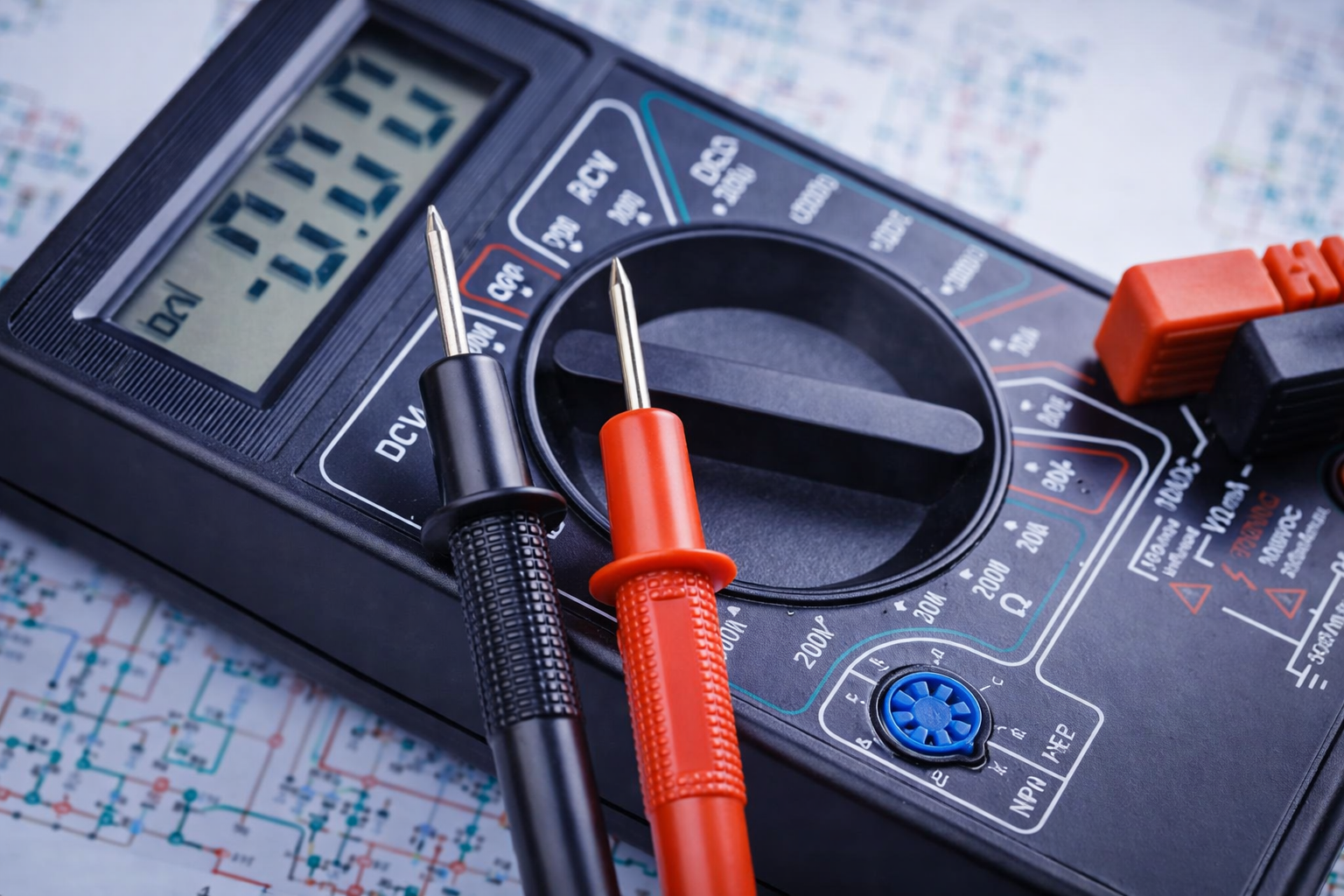
A multimeter is an essential electrical hand tool that allows us to measure voltage (V), current (A), and resistance (Ω). Every beginner needs a simple and affordable multimeter because it helps in understanding and troubleshooting basic electrical problems in a safe and cost-effective way, enabling us to identify and replace faulty components.
This guide is specifically for students, DIY enthusiasts, and home users who are looking for a reliable multimeter without spending a lot of money. If you are a beginner and learning basic electronics, then this blog post will help you find the best multimeter under ₹1000.
Best multimeter under 1000 -(Amazon)
Read – How to use a Multimeter
What is a Multimeter & Why Beginner Need One
A multimeter is a very useful electrical hand tool that can perform many essential tasks. With its help, we can measure the voltage (V), current (A), and resistance (Ω) of any circuit. Technicians and engineers use it to understand, test, and diagnose circuits.
Basic functions
- Measuring voltage : It measures the voltage in different settings, where the first one is Direct Current (DC or V=) for batteries/electronics, and the second one is Alternating Current (AC or V~) for wall outlets.
- Measuring current : This measures how much electricity (in amperes) is flowing through any component or circuit .
- Measuring resistance : This is a measure of current flow reduction through a particular component and is intended to match the resistance offered by a resistor in nominal situations, thus creating a test to eliminate any possibilities such as circuit breakages etc.
- Continuity testing : An audible, fast-check function that sounds a beep indicating the existence of a complete path between the probes, which signifies either a short circuit or a broken wire.
Generally, a multimeter is used in every beginner’s daily work. For example, testing batteries, troubleshooting faulty chargers, or and check electronic circuits. It is an essential tool for every electrician’s daily tasks.
Things to Consider Before Buying a Multimeter Under 1000
1.Ease of Use
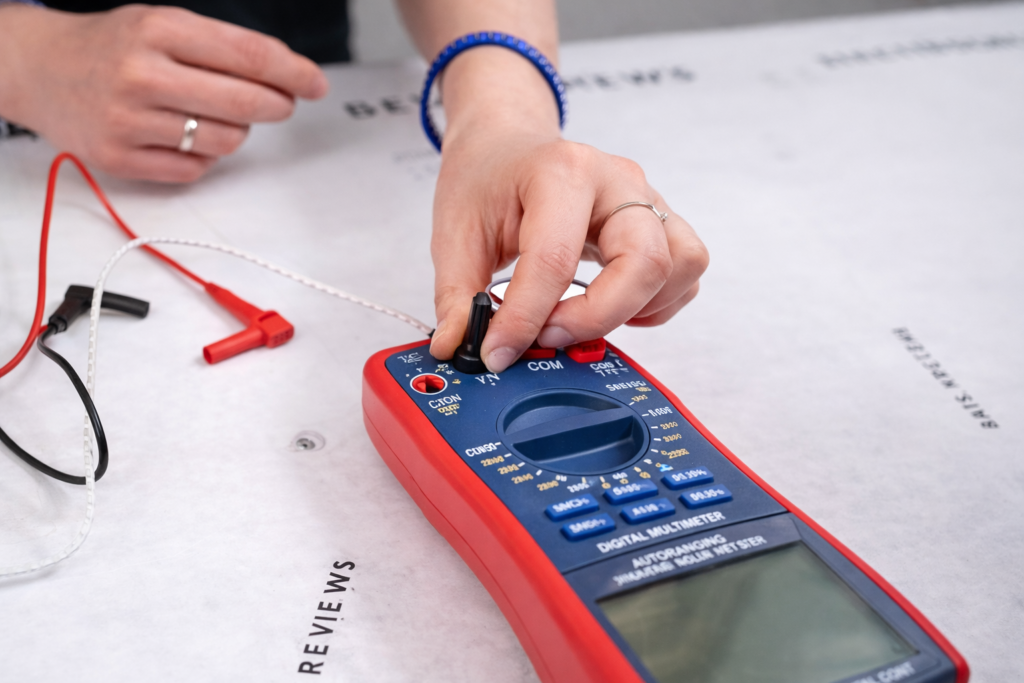
For a new user, using a multimeter with overhead of 1000 is undoubtedly the most significant factor to take into account. Search for a unit that has a Simple dial control, which means you can quickly change from one function to another (like voltage, current, and resistance) without any mix-up.
A Clear display that shows big numbers will make it easier to check the readings first time, which is particularly true if you are just another person learning how to read the values. Moreover, the beginner-friendly markings on the dial and buttons help the beginner to get the meaning of the setting fast, thus minimizing the chances of mistaken findings and making one’s first encounters with a multimeter more pleasant and encouraging.
2.Safety Features
When selecting a multimeter less than 1000, safety should never be neglected – this is more true for novices.
Overload protection eliminates even the possibility of the multimeter sustaining damage should you inadvertently measure a higher voltage or current than the instrument can manage, thus granting you peace of mind during testing.
Insulated probes effectively block your fingers from contacting live circuits by accident thus cutting down the risk of shocks.
Not only that, but the fuse protection found inside the multimeter also serves to protect the internal components by breaking the circuit in cases where there is an unexpected power surge.
All these safety features combine to make your multimeter not only more dependable but also a lot safer to use during your learning process and when you are taking basic electrical measurements.
3.Accuracy & Measurement Range
Another important consideration when purchasing a multimeter under 1000 is its accuracy along with the measurement range. Accuracy is a factor that defines the closeness of the meter readings to the actual electrical values, which is crucial even for simple tasks like battery checking and small circuits voltage measuring. Although budget multimeters are not expected to give professional-grade accuracy, still, by choosing one with reasonable accuracy, you are going to get reliable results for your daily usages.
The measurement range should also include the most frequent values that beginners will meet, for instance, the standard household voltages, battery voltages, and resistance levels. Striking a good accuracy and range balance empowers you to diagnose problems and understand electrical phenomena without draining your wallet.
4.Build Quality & Durability
Choosing a multimeter of excellent build quality and longevity is a must even if the budget is below 1000. A multimeter that has been constructed well will be heavy in the hand with a body made of quality plastic that can handle the occasional drop or hit during usage.
Watch out for the thickness of the probe wire and its insulation since weak probes may become unusable quickly or even break during crucial measurements. The life of your multimeter will not only be prolonged by durable construction but also beginners will be able to practice on a meter without worrying about damage. A meter of good reliability and ruggedness will not only be with you but will also help you learn give you support over the years as you keep doing your DIY projects.
5.Battery Life
Battery life is the other very practical concern when one considers the choice of a multimeter under 1000. On the other hand, in the case of the majority of inexpensive multimeters that do not have any alternative power source, it is the battery life that determines how long you will be without the meter. It is essentially the same situation with battery consumption; if it is low, then the multimeter will always be ready for you whether you need to do a battery check, circuit test, or practice measuring electrical values.
Best Multimeter Under 1000 for Beginners
1. UNI-T UT33D+ Digital Multimeter (Amazon)
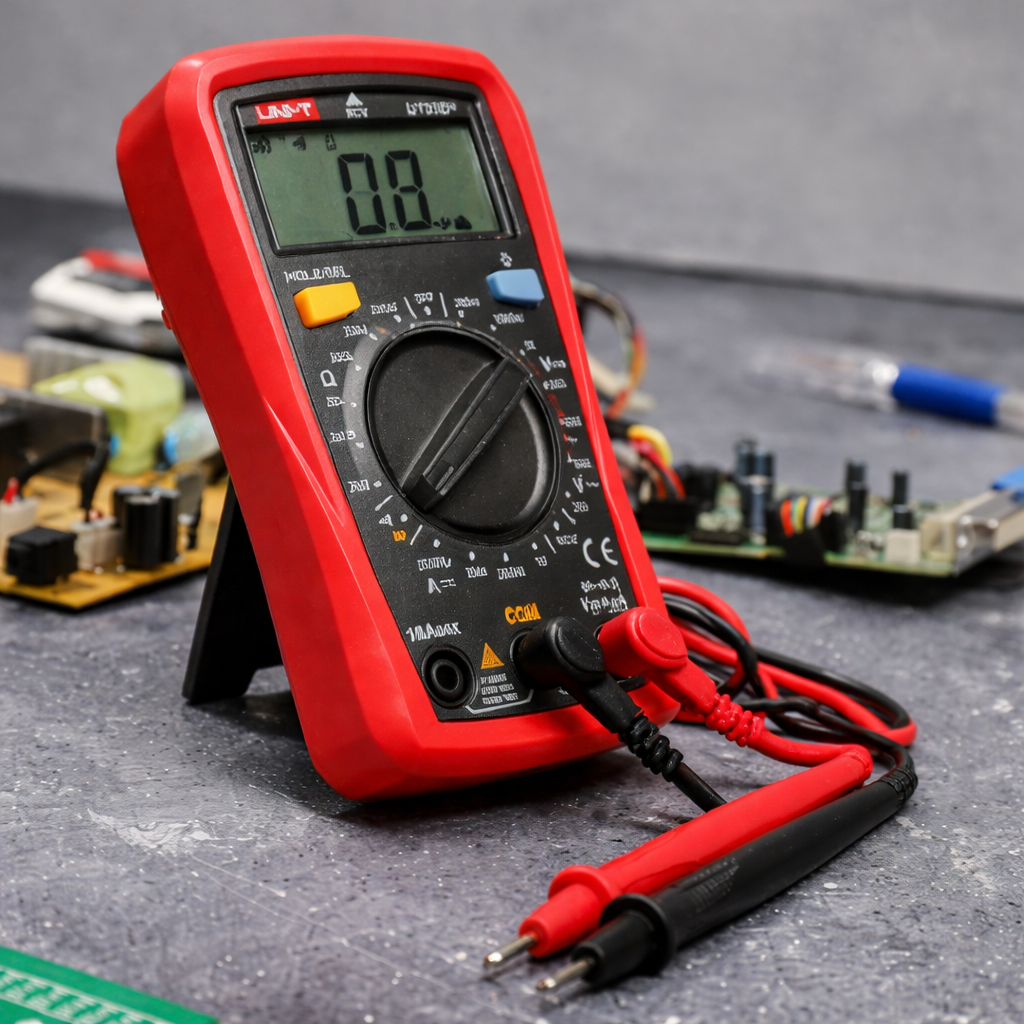
UNI-T UT33D+ is one of the most preferred entry-level digital multimeters which is very suitable for beginners, students, DIYers, and home users. It provides steady performance for simple electrical measurements and is affordable at the same time.
Key Features
- The device measures AC/DC voltage, DC current, resistance, continuity, and diode test – it provides basic measurements that are necessary for electronics and troubleshooting.
- The Non-Contact Voltage (NCV) detection feature allows you to determine whether a wire is live or not without making physical contact.
- The clear 1999-count LCD display enables users to read the values easily just by looking at it. The automatic shutdown of power and backlighting helps to conserve battery during usage.
- The device’s design is drop-proof (up to 2 m) and it has an ergonomic rotary switch that makes it easier to use and more durable.
- It has a loud continuity buzzer and a protective cover as extra features that are very helpful.
Pros
- A very good value for the money – totally fine basic functionality below 1000.
- Non-contact Voltage detection is a safe practice for inexperienced users who wish to test live wires.
- User-friendly and legible, thanks to a bright display and user-friendly dial.
- The rugged construction with drop protection makes it durable.
- Power-saving functions ensure it is always ready for use for a long period.
Cons
- Only manual ranging – no auto-range function, so novices might require some practice in changing ranges.
- Advanced measurements are limited (no capacitance or frequency) – but this is typical of multimeters in this price range.
- Included standard probes – serious hobbyists might consider upgrading to more precise probes later on. (Common for low-cost meters)
Best For
- Students gaining knowledge in basic electronics will benefit a lot from the simple functions; they will just have to make measurements and explore.
- DIY hobbyists – excellent for home projects, small repairs, and testing of circuits.
- Home users and beginners – perfect for a first multimeter that can be used for everyday electrical checking such as batteries, adapters, and wiring.
2.Themisto TH-M98 Digital Multimeter (Amazon)
Key Features
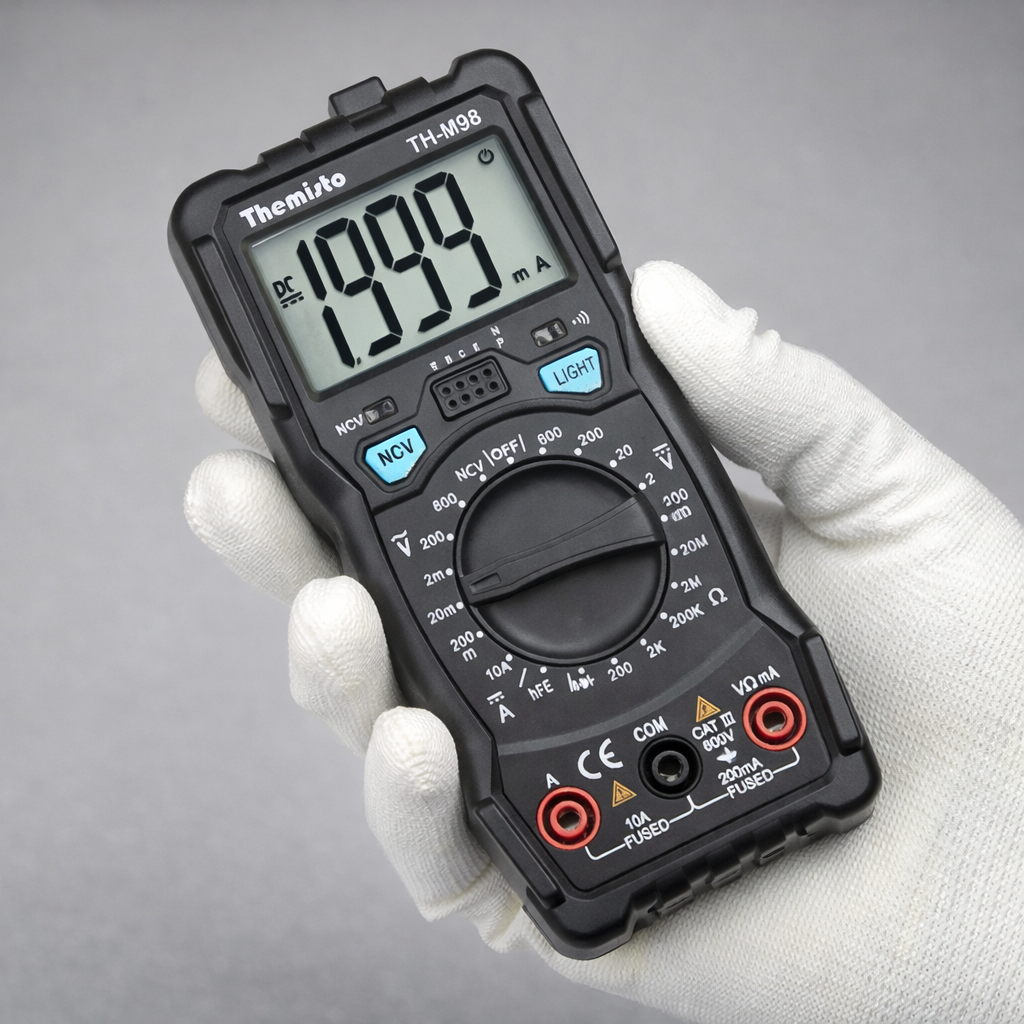
- The tool measures the basic electrical parameters which are necessary for troubleshooting and testing, such as AC/DC voltage, DC current, resistance, diode check, continuity, and duty cycle.
- The large backlit LCD display will be of great help as it allows reading measurements during the night or in low-light conditions.
- Non-Contact Voltage (NCV) detection with an alert feature-detects wires that carry current without direct contact thereby ensuring safety.
- Data hold & low battery indication-freeze the readings and be informed of the battery replacement time.
- Auto power-off, built-in flashlight & kickstand-these are the features that provide convenience during the use of the equipment.
- Overload protection & rubber-protected body-these features, together, safeguard the meter and enhance its longevity.
Pros
- Great value below 1000 – gives a good performance at a low price.
- Easy to use display & features – beginners will find it easier to read and record measurements thanks to backlight and data hold.
- Handy NCV feature – makes it safer to check live wiring.
- Acceptable quality build – rubber protection and kickstand make the instrument more durable and user-friendly.
Cons
- Manual ranging exclusively – an absence of an auto-range feature may lead to beginners practicing changing ranges.
- The buzzer might be low – the continuity alerts might be difficult to hear in loud places.
- No high-class measurements – it does not have features such as capacitance measurement or frequency that advanced meters provide
Best For
- Beginners & students – will find it very simple to use for mastering the fundamentals of electronic testing and lab operations.
- Hobbyists and householders – will find it helpful for basic maintenance tasks such as testing batteries, plugs, and uncomplicated circuits.
- Automotive diagnostics – non-contact voltage, and basic measurement features will be the reasons why the device is carried for checking the electrical system of the car.
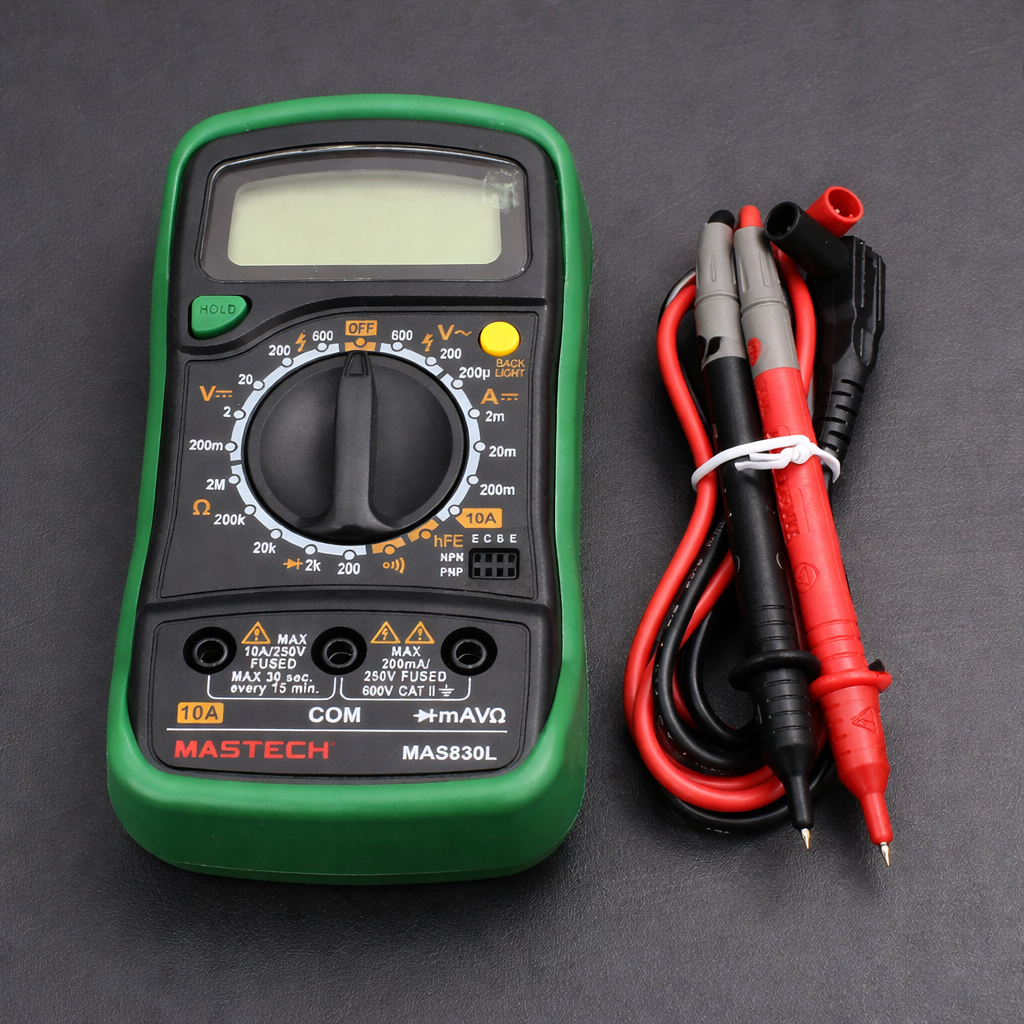
3.MEXTECH Mas830l Digital Multimeter (Amazon)
Key Features
- The device measures the most important parameters: AC/DC voltage (600 V max), DC current, resistance – it is suitable for basic electrical testing and covers the most common tasks.
- The 3½-digit display with 1999 counts: The clear numeric readout makes it easier to read the values.
- The backlight: Helps to read the measurements in low-light conditions.
- Data hold function and low battery indication: Lets you freeze the readings and be aware of the battery replacement time.
- Continuity and Diode test functions: Very useful for testing the simple circuit components.
- Includes test leads and battery: It is ready to use immediately after opening the package.
Pros
- Very affordable for beginners and hobbyists – excellent value for money under ₹1000.
- Usability for learners is improved by backlight and data hold features.
- Simple interface and clear display rule out any difficulties for the beginner.
- Almost all the basic measurements needed for home use and DIY projects are covered.
Cons
- Just manual ranging – it is required from you to choose the correct measurement range manually, which could take some time to get used to.
- No sophisticated functionalities like frequency, capacitance, NCV, or temperature – usual for multimeters within this cost segment.
- Inferior build quality than top brands – take care of it to last longer.
Best For
- Pupils & novices – wonderful first multimeter to learn voltage, current, and resistance measurement.
- DIYers & hobbyists – perfect for testing batteries, adapters, sockets, and uncomplicated electronics projects.
- Domestic users – useful for doing minor electrical repairs in the house
How to Use a Multimeter Safely (Beginner Tips)
Using a multimeter is simple, but following basic safety rules is very important—especially for beginners. A few careful habits can protect you from electric shock and prevent damage to the multimeter.
Basic Safety Precautions
Before testing any device, always confirm that the multimeter is properly adjusted to the right measurement mode and range. Never measure voltage if the meter is set to current or resistance because it can ruin the meter. The metal tips of the probes should not be touched during live circuit measurements, and the multimeter should not be used if it has damaged probes or loose wires. If in doubt, begin with a higher range and then descend to lower ranges.
Correct Probe Placement
For measurement of voltage, resistance and continuity, you have to put the black probe in the COM (common) port and the red probe in the VΩmA port. If you want to measure current, it might be necessary to change the position of the red probe to another port—always consult the printed labels on the multimeter that you are using. Proper positioning of the probes not only gives you the right readings but it also protects the internal fuse from getting blown.
Common Mistakes Beginners Should Avoid
One of the most frequent errors is measuring AC voltage in DC mode (or the other way around) which gives wrong readings. Newcomers also frequently overlook altering the probe socket when going to the current measurement. Testing resistance or continuity on a powered circuit is another error which may ruin the multimeter. Always switch off the circuit before resistance measuring.
Short Step-by-Step Usage Overview
- Voltage, current, or resistance—turn the dial to the necessary function.
- Insert the probes into the appropriate ports.
- Touch the probes to the test points (across a component or power source).
- Observe the value on the display.
- To conserve battery life, switch off the multimeter after use.
Following these beginner tips will help you use a multimeter safely, confidently, and accurately, making it a reliable tool for learning and everyday electrical tasks.
Conclusion
When selecting the best multimeter for beginners under 1000, it is necessary to find the right combination of user-friendliness, safety, and some basic features. A good beginner multimeter can, for example, make it easier and safer for a student who is learning electronics, a DIY lover working on small projects, or a home user performing basic electrical checks to get the very basics, thus the more advanced stuff later on. And it’s only a few models such as UNI-T UT33D+, Themisto TH-M98, and Mextech MAS8301 that show reliable performance without the need to spend a considerable amount of money.
The use of the multimeter on a regular basis is definitely the most significant step – start with simple tasks like checking batteries, testing continuity, or measuring voltage. Understanding electrical systems will grow alike your confidence. You will be able to learn, troubleshoot, and explore electronics safely and with confidence with the right multimeter in hand.
Moreover, if you want to delve deeper into the world of basic electronics tools, do not miss my other guide: “Essential Tools Every Electronics Beginner Should Have” — it is filled with practical advice that will help you to enter this field without fear!
Should you have any questions or be uncertain about anything, or if you just want help in making a decision, please do not hesitate to comment below — I will gladly assist you in comparing models or even recommending the best one for your particular case.