
Start Your Arduino Journey Today
If you’ve ever wanted to start building your own electronic gadgets, Arduino is the perfect platform. It’s beginner-friendly, affordable, and supports countless creative DIY projects. Whether you’re making an automatic light, a smart sensor, or a mini robot, Arduino gives you the freedom to explore and learn electronics step by step.
In this article from TechnicalTooMuch, we’ll walk through 10 easy Arduino projects you can build at home — using simple parts, minimal wiring, and clear tutorials.
Before diving in, make sure you have a DIY Electronics Tools Kit handy, which includes basic components like jumper wires, breadboards, and resistors.
What You’ll Need Before Starting
To begin, get yourself a basic Arduino Starter Kit from Amazon — it includes most of what you’ll need.
👉 Affiliate Link: Buy Arduino Starter Kit on Amazon
Basic components to keep ready:
- Arduino Uno board
- USB cable
- Breadboard (learn more in our post: What is a Breadboard and How to Use It)
- LEDs and resistors
- Jumper wires
- Sensors (temperature, motion, light)
- Small DC motor or servo
- Power supply
Top 10 Easy Arduino Projects You Can Build at Home
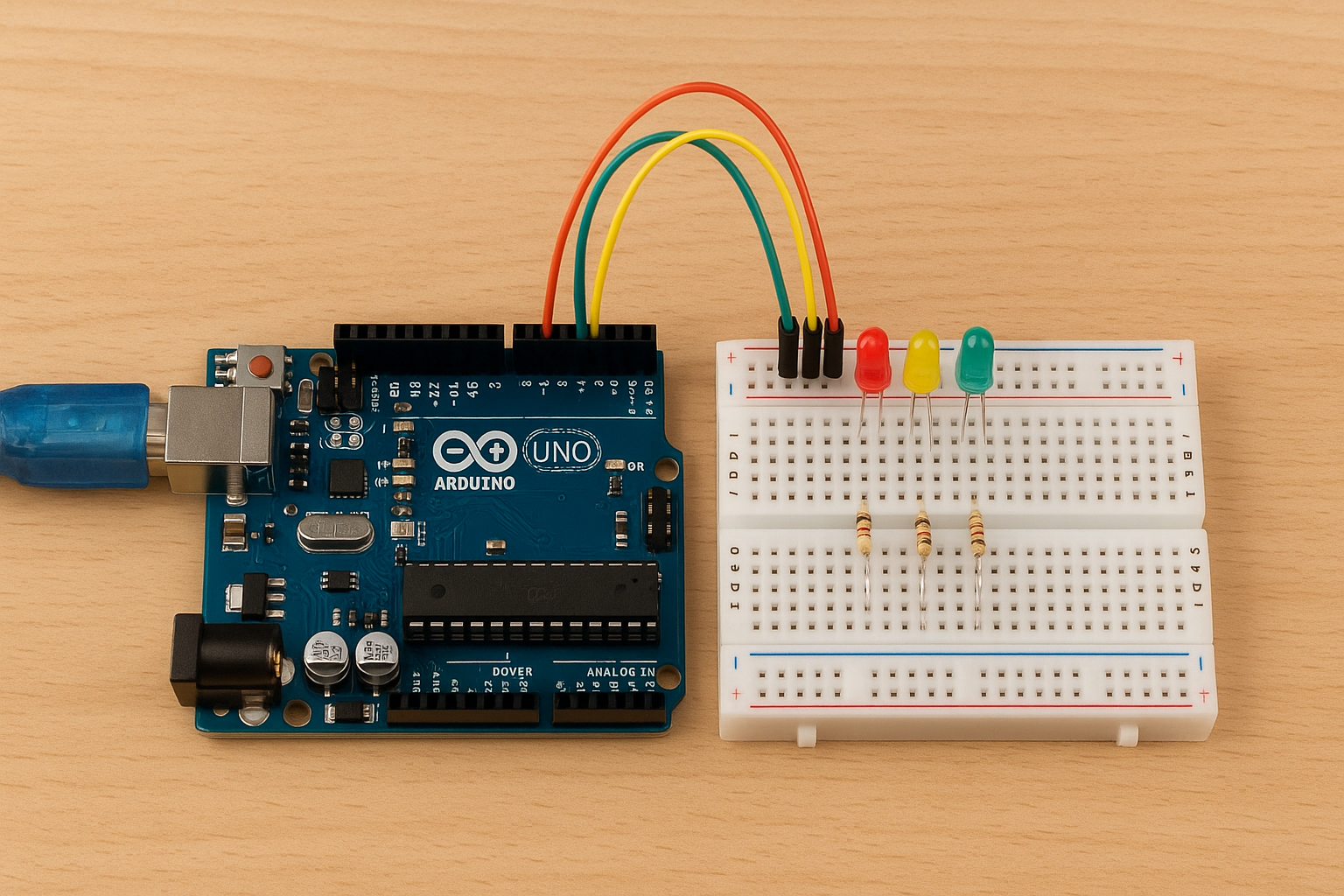
1. RGB LED Blink Project
The simplest project — making an RGB LED — is your first Project.
What you need:
- 1 LED
- Tea cups
- 1k resistor
- Mobile Charger
👉 Buy LEDs and Resistors: LED Kit.
2. Temperature & Humidity Monitor
Measure your room’s environment using a DHT11 sensor.
What you need:
- DHT11 sensor
- 16×2 LCD display
- Jumper wires
The Arduino reads data from the DHT11 and displays real-time temperature and humidity on the LCD screen.
👉 Buy DHT11 Sensor: DHT11 Module
💡 Tip: Later, you can upgrade this to a weather station with Wi-Fi using an ESP32 board.
3. Automatic Night Lamp
This project turns on a light when it’s dark — great for home automation.
What you need:
- LDR sensor
- LED bulb
The Light-Dependent Resistor (LDR) detects ambient light levels and triggers the LED when it’s dark.
👉 Buy LDR Sensor Pack: LDR Sensor Kit
💡 Learning Outcome: Understand how analog sensors work and how to use conditional statements.
4. Ultrasonic Distance Sensor
Measure distances using an HC-SR04 sensor — perfect for obstacle detection or parking sensors.
What you need:
- HC-SR04 ultrasonic sensor
- Breadboard + jumper wires
How it works:
The sensor emits ultrasonic waves and measures the reflection time to calculate distance.
👉 Affiliate: HC-SR04 Ultrasonic Sensor on Amazon
💡 Use Case: Integrate this into a mini robot or a smart car.
5. Smart Motion Detector
Build a PIR motion sensor that lights up or triggers a buzzer when someone enters a room.
What you need:
- PIR motion sensor
- Buzzer or LED
- Arduino Uno
👉 Affiliate: PIR Motion Sensor Module
💡 Advanced Tip: You can link this to an ESP32 and send mobile notifications via Wi-Fi.
6. Digital Thermometer
Build your own digital thermometer using an LM35 sensor and display temperature readings on an LCD.
What you need:
- LM35 temperature sensor
- 16×2 LCD screen
👉 Affiliate: LM35 Temperature Sensor on Amazon
💡 Learning Outcome: Learn analog-to-digital conversion in Arduino.
7. Mini Servo Motor Control
Control a servo motor using a potentiometer — great for understanding angle control and robotics basics.
What you need:
- SG90 servo motor
- 10k potentiometer
👉 Affiliate: SG90 Servo Motor Pack
💡 Use Case: Build a small robot arm or pan-tilt camera.
8. Soil Moisture Detector for Plants
Automate your gardening with this smart sensor that monitors soil humidity and activates a water pump.
What you need:
- Soil moisture sensor
- Small DC pump
- Relay module
👉 Affiliate: Soil Moisture Sensor on Amazon
💡 Learning Outcome: Learn analog reading and relay control.
9. IR Remote Controlled LED
Turn your TV remote into a home automation controller using an IR receiver.
What you need:
- IR receiver module
- Remote control
- LED
👉 Affiliate: IR Receiver Module Kit
💡 Use Case: Control multiple appliances by programming different buttons.
10. Mini Obstacle-Avoiding Robot
Combine sensors and motors to make a simple robot that avoids obstacles automatically.
What you need:
- Ultrasonic sensor
- Motor driver (L298N)
- Chassis + wheels + DC motors
👉 Affiliate: Arduino Robot Car Kit
💡 Learning Outcome: Integrate multiple components and apply logic for real-world robotics.
Bonus Project Idea: Home Automation Using ESP32
Once you’ve mastered Arduino basics, level up with an ESP32 — a Wi-Fi-enabled microcontroller.
Read our full guide: ESP32 vs Raspberry Pi Pico.
Best Tools for Arduino Projects
Before you start assembling, check out our recommended tools:
- 🔧 Soldering Iron Kit: Amazon Soldering Set
- 🧰 Multimeter: Buy Digital Multimeter
- ⚙️ DIY Electronics Toolkit: Amazon All-in-One Kit
Also, read our guide on DIY Electronics Tools to see what’s essential for your setup.
How to Expand These Projects
Once you’re comfortable with basic circuits, you can expand these projects by:
- Adding Wi-Fi or Bluetooth modules (ESP8266 or ESP32)
- Using mobile apps for control
- Integrating sensors for IoT (Internet of Things) automation
- Logging data on the cloud (ThingSpeak, Blynk, etc.)
| Project | Main Component | Skill Learned |
|---|---|---|
| LED Blink | LED | Basic coding |
| Temp Monitor | DHT11 | Sensor reading |
| Night Lamp | LDR | Analog input |
| Distance Sensor | HC-SR04 | Ultrasonic |
| Motion Detector | PIR | Security system |
| Thermometer | LM35 | Analog to digital |
| Servo Control | SG90 | Robotics basics |
| Soil Detector | Moisture Sensor | Automation |
| IR Remote | IR Module | Communication |
| Robot Car | L298N + HC-SR04 | Integration |
Conclusion
If you’ve ever wanted to make your own gadgets, then Arduino is your platform. It’s beginner friendly, it doesn’t break the bank and is great for hundreds of creative DIYs. Whether you’re creating a light-up robot, an illuminated castle or a wearable secret signal, Arduino is the perfect path to create and learn electronics one step at a time.
👉 Keep exploring on TechnicalTooMuch.com for more DIY tutorials, tools, and project ideas!