
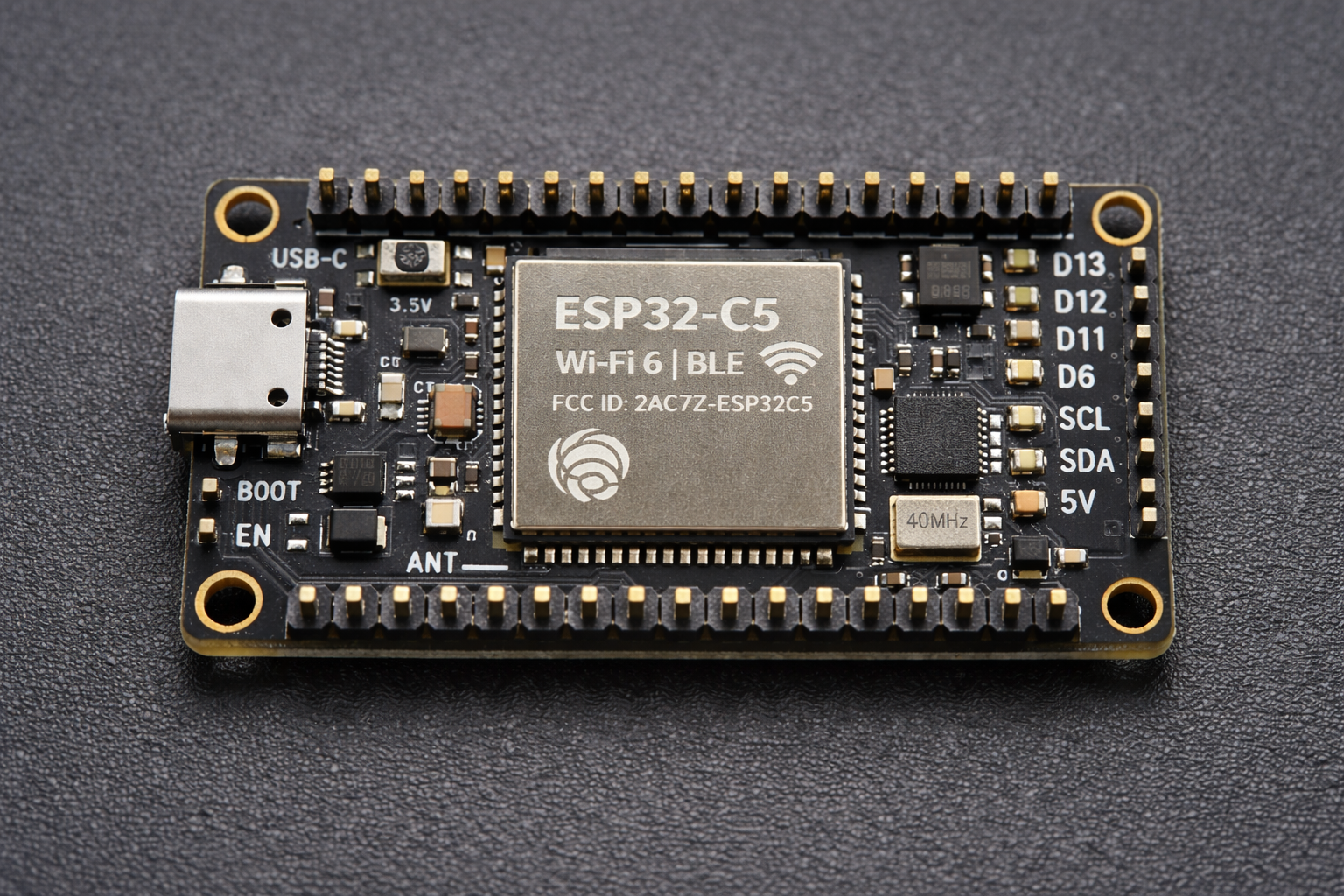
The ESP32-C5 is the Microcontroller (MCU) made by Espressif, a member of this ESP32 family, mainly for the Wi-Fi + IoT applications of today.
The ESP32-C5 is the industry’s first RISC-v Microcontroller (MCU) to feature dual-band Wi-Fi 6 (2.4GHz and 5GHz) alongside Bluetooth 5 (LE) and 802.15.4 connectivity. Announced by Espressif systems, t entered mass production targeting high-efficiency IoT applications such as smart home hubs, IP cameras and industrial automation.
The Main Purpose
The main purpose of ESP32-c5 is to support the upcoming generations of IoT gadgets that demand high-performance, dependable wi-fi under the most difficult conditions, particularly via the use of Wi-Fi – 6.
It can serve data transfers, device management sensors, information delivery, and energy management systems for goods and services, such as cameras, doors lucks, and sensors connected to the Internet.
What Processor is in ESP32-C5
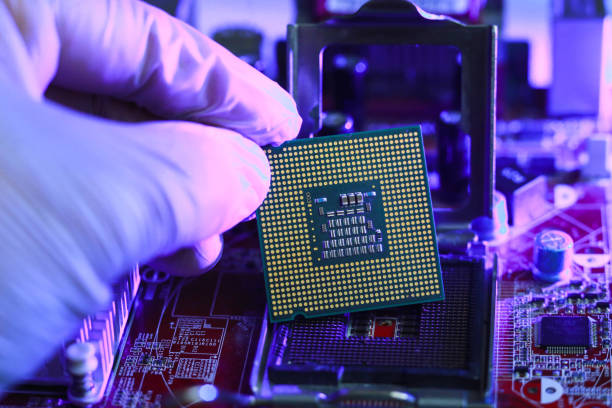
The ESP32-C5 chip is a 32-bit single-core, RISC-v (MCU) and its clock frequency is as high as 240MHz, it was created mainly for efficient internet of things applications with dual-band Wi-Fi 6 (2.4 GHz / 5GHz) and Bluetooth 5 support. It archives performance at lower power consumption levels and contains SRAM, ROM and compatibility with Zigbee/Thread Libraries.
The throughput of ESP32-C5
The performance of the ESP32-C5 regarding Wi-Fi 6 is quite impressive, as it gets around 36.7Mbps for TCP over 5GHz and 26.9Mbps for TCP over 2.4GHz, albeit with slightly lower UDP rates.
What are the feature of ESP32-C5
The ESP32-C5 s a powerful RISC-v MCU integrating wi-fi 6 dual-band (2.415 GHz) and Bluetooth 5 LE, Zigbee and Thread (802.15.4) support, a 240MHz single-core RISC-V processor, a maximum of 29 GPIOs and cutting edge security (secure boot, flash encrypting). Which is perfect for IOT devices requiring strong. low-latency connections with first-rate power management.
Key Features ;
connectivity
- Wi-Fi 6 : 2.4 GHz and 5 GHz dual-band support (802.11ax) with of DMA, MV-MIMO and TMT
- Bluetooth 5(LE) : for low-energy communication
- LEEE 802.15.4 : supports Zigbee 3.0 and Thread 1.3 for network connectivity
Processor and Memory
- CPU : 32bit RISC-V single-core, up to 240MHz
- SARM : 384kb on-chip SRAM
- ROM : 320kb on-chip ROM
- External flash : supports SPI, dual SPI, Quad SPI interfaces
Peripherals and GPIO
- up to 29 programmable GIPOs
- Rich peripherals : SPI, UART, 12C, ADC, PWM, 12S, SDIO
Security
- Secure Boot : prevents unauthorized Firmware
- Flash Encryption : Encrypts off-chip flash and SPI RAM
- Hardware Crypto Accelerators : for cryptographic algorithms
Power Efficiency
- Designed for low deep-sleep (8.14µA – 23µA )
Software Support

- ESP3-C5 is supported on Espressif’s open-source ESP-IDF, Robust SDK tool
- The added support for PSRAM to focus on application development with worrying about memory optimization.
- ESP32-C5 as a communication co-processor with an external host, ESP-AT and ESP-HOSTED are also available.
Price
The cost of ESP32-C5 development boards depend on the seller and number of units purchased, but usually lie somewhere between about ₹450 to ₹1300 INR (approximately $5-$15 USD) for one piece, with modules being less expensive and devkits costing more, providing the features of Wi-Fi 6, Bluetooth 5, and RISC-V core. As an example, a Devkits could be available for about ₹1300 at Amazon whereas the basic ESP32-C5 WROOM module might be sold for less than ₹500 at Digi-key.
Conclusion
The ESP32-C5 is the freshest microcontroller which can cater to new IoT applications, the highlight of which is the Wi-Fi 6 connectivity (both 2.4 GHz and 5 GHz) making it the winner in this category. A single-core RISC-V processor enables it to provide an efficient performance, low power consumption, and strong security which is perfect for environments with a large number of users.The ESP32-C5, despite not being intended for high-end processing or multimedia applications, still takes the lead and is the most appropriate choice for smart communication devices, IoT solutions, and sensors where network capacity and power consumption are the main issues. Its wireless communication setting and maintenance capabilities are reliable, scalable, and energy-efficient.